
Post Therapy Growth: Building on What You’ve Learned
It’s common to leave a therapy session feeling emotionally raw, vulnerable, or even heavy. In the important work that’s done in therapy, a lot of emotions can be stirred up. However, the stirred-up emotional state can make it difficult to transition from therapy to whatever’s next in your day, be it a Trader Joe’s trip to stock up for meal prep or off to your next shift at work.
In this article, we’ll explore how growth can continue long after therapy ends and how to stay connected to what you’ve learned in everyday life. Here’s a quick look at what we’ll cover:
What to expect in a therapy session and how the process can support meaningful change
How to get ready for a therapy session so you can show up feeling more grounded and open
A simple 5-minute rhythm you can incorporate post-therapy to stay connected to your growth
If you’re curious about how to keep growing after therapy, this article will offer gentle, practical guidance to help you move forward with intention.
What to Expect in Your First Therapy Session
If it’s your first experiencegoing to therapy or you’ve gone before but felt it didn’t quite click, you may be unsure of what to expect from your therapist.
While every therapist practices in a manner suited to their unique style and theoretical orientation, there are a few key things that good therapy should provide you as the client. Afterall, you don’t want to pay for a conversation that could’ve been had over coffee with a good friend.
Here are appropriate baseline expectations for therapy:
Clear goals about what “getting better” looks like to you
Honest and professional feedback about the struggles you’re facing
Skills, tools, or new mindsets to help facilitate growth in between sessions
What are the symptoms or challenges of post therapy hangover?
Post-therapy can sometimes feel like a psychological hangover. You may notice emotional sensitivity, less structure, uncertainty, or a need to adjust to normal life without the same therapeutic support.
Established goals for treatment
For therapy to be productive, there must be goals that are being worked towards. In the same way that driving in a new place without directions or an address feels fruitless, therapy without an end goal can feel meandering and unmeaningful.
It is your therapist’s job to facilitate creating a treatment plan that establishes the point of pain where you are right now and the end goal for improvement in specific areas of life.
You get to decide what growth looks like and what you’re aiming for, and it’s your therapist’s job to facilitate the session in a meaningful way towards exploring those goals.
Feedback about what you share
While it’s true that good therapy is non-judgmental and client-centered, you don’t want to spend the whole session talking without any input from your therapist. You can expect your therapist to act like a mirror, reflecting to you insights about what you share.
This may mean that your therapist will provide psychoeducation relevant to the challenges you’re facing. Your therapist may make observations about you and bring them to your awareness, such as noting your body language or inviting you to be curious about your emotions as you’re sharing.
Your therapist should not give you their personal opinions or feedback about what decisions in your life you should or should not make.
Skills for outside of the session
An hour a week, or every other week, may be all you need to achieve the growth you’re after, but sometimes we need more. Your therapist can be expected to offer you suggestions about how to implement the change you’re seeking in your life, which may require learning new skills, acquiring new tools, or developing new mindsets.
This may involve
Physical practices for how to care well for your body
Mental practices to help you attend to your thoughts in a new way
Emotional and relational skills to navigate matters more effectively
Some therapists also suggest books that assist in developing a new way to think about what you’re experiencing.
If you’re feeling like you’re needing more from your therapist in the way of skills and tools outside of session, know that it’s okay to ask for more—they may be holding back due to not wanting to overwhelm you with more “to-dos.”
What should I do if I feel like I’m backsliding after therapy?
Backsliding does not mean failure. A helpful guide is to return to the steps to take that supported your wellness before, and reach out to a qualified therapist if you need more support.
How to Get Ready for Your Therapy Session
It’s no secret that therapy is an investment, so if we’re going to carve out the time and money, we might as well make the most of it! One of the most effective ways to prepare for therapy is to spend 10-15 minutes before the session reflecting and/or meditating.
Here are three questions to consider in your reflection time to ensure your therapy hour is used well:
What have I been noticing?
Consider the time in between sessions and scan for anything you noticed in yourself. If you keep a journal, reference what you reflected on in your entries. Here are some examples:
It may be that you noticed feeling especially distressed when your boss gave you feedback about an assignment.
Maybe you noticed being able to name an anxious thought and let it pass.
Perhaps you noticed feeling triggered by a particular scene in the show you’re watching.
It may be that you noticed feeling afraid when you voiced your need to your partner the other day.
You are the expert on you, so building your own self-awareness of what you experience in between therapy sessions is invaluable to the work that you’re doing with your therapist.
Where you experience distress in life indicates a potentially important area for exploration in counseling.
Has progress been made from the last session?
Hopefully, you’re leaving therapy feeling new insights are coming forth, new skills are being developed, or distress is alleviating. Consider how the previous session ended and evaluate if progress in that area has further developed – or remained the same.
If your therapist suggested trying a new thing, did you try it? Was it helpful? Even if you didn’t do what your therapist suggested, consider what prevented you from trying it.
Perhaps create a “Post-Session” notebook with any new skills or tools that you want to incorporate into the week ahead. Consider if there was anything that came up in the session that you want to spend more time reflecting on. Note if there’s anything you felt you didn’t have enough time for and would want to circle back to in the next session.
What do I need from the therapy hour today?
When being introduced as a therapist, I’ve been asked if I can read minds – that would be both amazing and terrifying! Your therapist may know you well, but can’t always discern what you need from the therapy hour. It can be helpful to go in with some awareness of your needs. Here are some examples:
You may need to spend the session sharing about your grief
You may need to spend the session unpacking the dispute you had with your boyfriend
Perhaps you need to know someone sees you and cares about what you’re feeling
Perhaps you need a new way to calm your body when you’re triggered
Maybe there’s a big decision coming up, and you’re not sure what move to make, so you need some clarity
Or perhaps you need to continue processing past traumas to alleviate the lingering distress
Whatever you’re facing, your needs are important, and you are your best resource in determining those needs. It can be difficult at first to pinpoint what we need, but even in those instances, it can be helpful to share, “I’m not sure what I need today.”
How to Support Your Growth Post Session
What happens after a therapy session can be just as meaningful as what happens during it. The time that follows often holds insight, emotion, and the beginnings of change, especially if you give yourself space to notice what is coming up.
Post-session care is not about doing everything perfectly. It is about creating room to reflect, settle, and stay connected to what felt important.
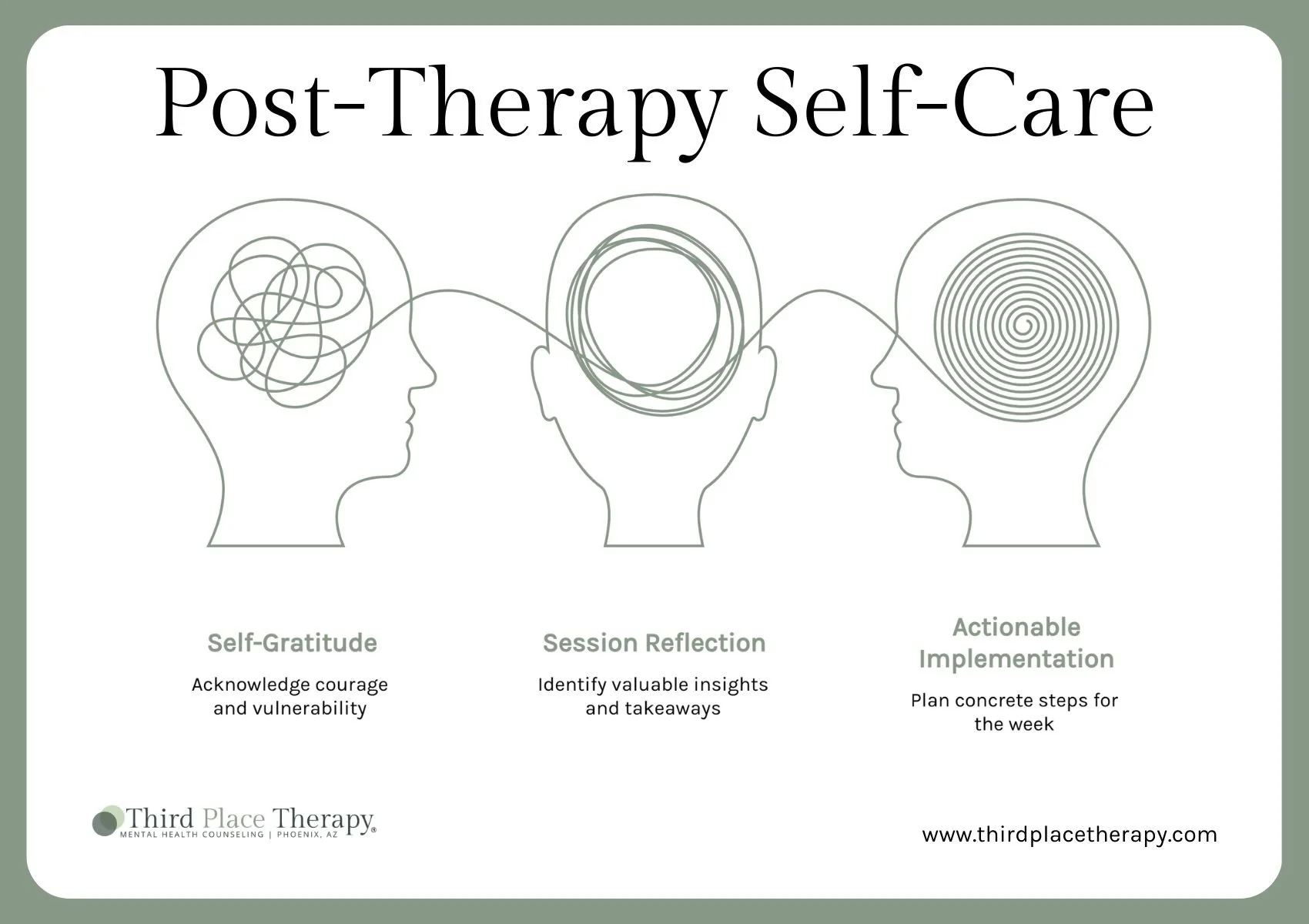
Here is a 5-minute rhythm you can incorporate post-therapy to make the most of your session and transition well into the next thing.
Set the Tone for Self-Care After Therapy
First, make sure you’re in a comfortable space, and start with self-gratitude.
Turn on the car’s air conditioning, lean the seat back, place your left hand over your heart, your right hand over your belly, and take three deep breaths. When you exhale, breathe out of your mouth as if you were breathing into a straw, and notice the sound of your breath.
Inwardly, acknowledge yourself for the courage it takes to show up to therapy and do the hard work of growth. Say something of gratitude for your willingness to be vulnerable.
Next, consider the following three questions.
1. What felt most valuable from today’s session?
Is there a topic that was discussed, insight that was gained, a new strategy you learned, or a connection that was made? Was there a moment in therapy that felt significant to you? What is your takeaway?
Sometimes what’s most valuable is:
A moment in session when you felt understood, seen, affirmed, challenged
A new concept you weren’t previously aware of
A grounding technique you learned about or tried
New self-awareness or clarity
2. Is there anything actionable I want to implement?
Is there anything that today’s session leads you to want to do, change, add, or remove in the next week? Was there a topic brought up or a book mentioned that you’d want to explore more?
Consider ways you can incorporate what’s been most helpful and meaningful in therapy into your week.
This may look like:
Setting a reminder on your phone to practice something you learned in session
Scheduling time to sit with your feelings a little longer and process what comes up
Reading that book
Having that hard conversation you’ve been avoiding

3. What am I feeling and needing right now?
Can you label the emotion you’re noticing right now? Do you feel at ease, unsettled, grateful, unsure, hopeful, curious, supported, etc.? Check out a Feelings Wheel for more ideas on specific emotions.
What do you need right now before transitioning to what’s next?
This may be:
Just a few more deep breaths
Making a note of things you want to spend more time on in the next session
A grounding practice to help you feel more grounded or contained
A hug from a loved one
Is it okay to go back to therapy after it has ended?
Yes, absolutely. Returning can be a healthy intervention, especially if you need to revisit something, want more structure, or are moving through a new milestone, complication, or life change.
Keep Building on What Therapy Has Already Begun
Creating a post-therapy rhythm can help you stay connected to the insight, emotional well-being, and self-trust that begin to take shape in session. Even a few minutes of reflection can support your well-being, strengthen your self-care routines, and help you manage difficult situations with more clarity and intention.
If you are looking for supportive, thoughtful care, we offer individual psychotherapy, couples therapy, EMDR, relationship therapy, and Internal Family Systems-informed work to help you cope with mental health issues, navigate setbacks, and build a stronger sense of self.
Our goal is to help you protect your emotional well-being, deepen self-understanding, and move through life with more strength, trust, and steadiness. If you’re ready for support, reach out to learn more and schedule an appointment.
